
Microsoft gives us a vision of how computing will be in the future (Silverlight required):
Tag: Learning
Matching the trends
What is good about spending 10 hours in a plane? You finally get the time to catch up on your reading. I read the Netlash trendrapport, and Stephen Downes’ The Future of online learning: ten years on.
Both reports were written from a different viewpoint and with a different scope, but it is interesting to see that they make similar observations:
- Interaction will be key: wether it is called social learning, conversation or social networking, technology will facilitate the fact that we can learn from each other.
- Technology once seen as futuristic can break through: I wrote this in San Diego on a 300$ netbook, you might read this as an RSS feed on your iPhone. Virtualization and cloud computing will change the way we work and learn.
- Connectivity and always-connected devices will allow us to interact with and learn continuously from people in our virtual network.
The ones who manage to deal with all these changes and use them in a creative way will survive. At least one thing that did not change…
Quotes from SharePoint Best Practices
It is an amazing experience to attend the SharePoint Best Practices Conference in San Diego. MVP speakers, a beautiful location, and very interesting content.
It’s impossible to summarize what I learned until now in a blog post, but these quotes will give you an idea of what’s happening:
- SharePoint is not about building software, it’s about building services.
- The most difficult thing about SharePoint is the people thing.
- Information that is hard to find, is hardly ever used.
- Vista is Microsoft’s gift to Apple.
To avoid that some people lose their MVP status, I will not tell anybody who made the last statement. 🙂
A strong limitation of Microsoft LCDS
I have been playing quite some time now with Microsoft’s Learning Content Development System. I promised in an earlier post to put some content online, but that is where it went wrong. I just could not get the content published in any other LMS than the SharePoint Learning Kit.
After some testing, it seems that the content needs to be hosted on… a Microsoft IIS server. All my test systems were running Apache, PHP and MySQL (as most open source lms systems do).
For me, these are some serious limitations to LCDS as an authoring tool.
Adding a new language to Microsoft LCDS
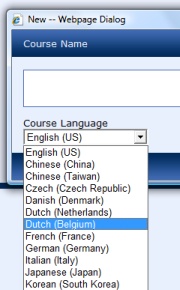 Someone asked me if it would be possible to add a new language to the available language packs of the Microsoft Learning Content Development System. Well, as the system supports already multiple languages, that should not be that difficult. This is what I did (use at your own risk!):
- Navigate to C:\Program Files\Microsoft\Learning\LCDSc\application\viewer. This folder contains a subfolder, one for every available language.
- Copy the folder that corresponds most to the language you want to create. Or if no correspondence, copy any folder and give it a three letter language code.
- Inside your new folder, go to the folder named shared. Inside that folder, there is a folder with the same language code, rename that to your new code.
- Inside that folder, there is a file version.xml. Edit the file in Notepad and make the necessary changes.
- Open the viewer folder inside that folder.
- The file viewerstrings.js contains the different language strings for the viewer. Edit the file in Notepad and translate.
- The Help and appart folder contain the help screens. Translate these if necessary.
- Go back to C:\Program Files\Microsoft\Learning\LCDSc\application and edit the supportedLanguages.xml file with notepad. Copy one of the lines to add a new line for your language.
Done! The new language should appear when creating a new course!